


Discover everything you need to know about Job Development Awards. This comprehensive guide covers their key benefits, eligibility criteria, and a step-by-step application process to help you secure funding and elevate your professional skills to the next level.
Navigating career growth often requires financial investment in training, certifications, and skill development. Many professionals find themselves constrained by limited budgets, unable to access the educational resources necessary to advance in their fields. Job Development Awards exist specifically to bridge this gap, providing essential funding to individuals and organizations committed to professional growth.
Understanding how these grants operate can drastically alter your career trajectory. These programs distribute financial resources to help workers acquire new skills, adapt to industry changes, and take on advanced roles. For employers, these awards serve as a powerful tool to upskill their workforce without draining corporate training budgets.
This guide breaks down the core components of Job Development Awards. You will learn what these awards entail, the primary benefits they offer to both employees and employers, and a clear, step-by-step method for submitting a successful application.
What Are Job Development Awards?
Job Development Awards are financial grants provided by government bodies, industry associations, or private foundations designed to fund workforce training and professional development. Their primary objective is to cultivate a highly skilled workforce capable of meeting the demands of modern industries.
Instead of general educational scholarships, these awards target specific vocational skills, certifications, and practical training programs. They align closely with economic demands, often focusing on sectors experiencing rapid growth or significant technological disruption.
Key Benefits of Job Development Awards
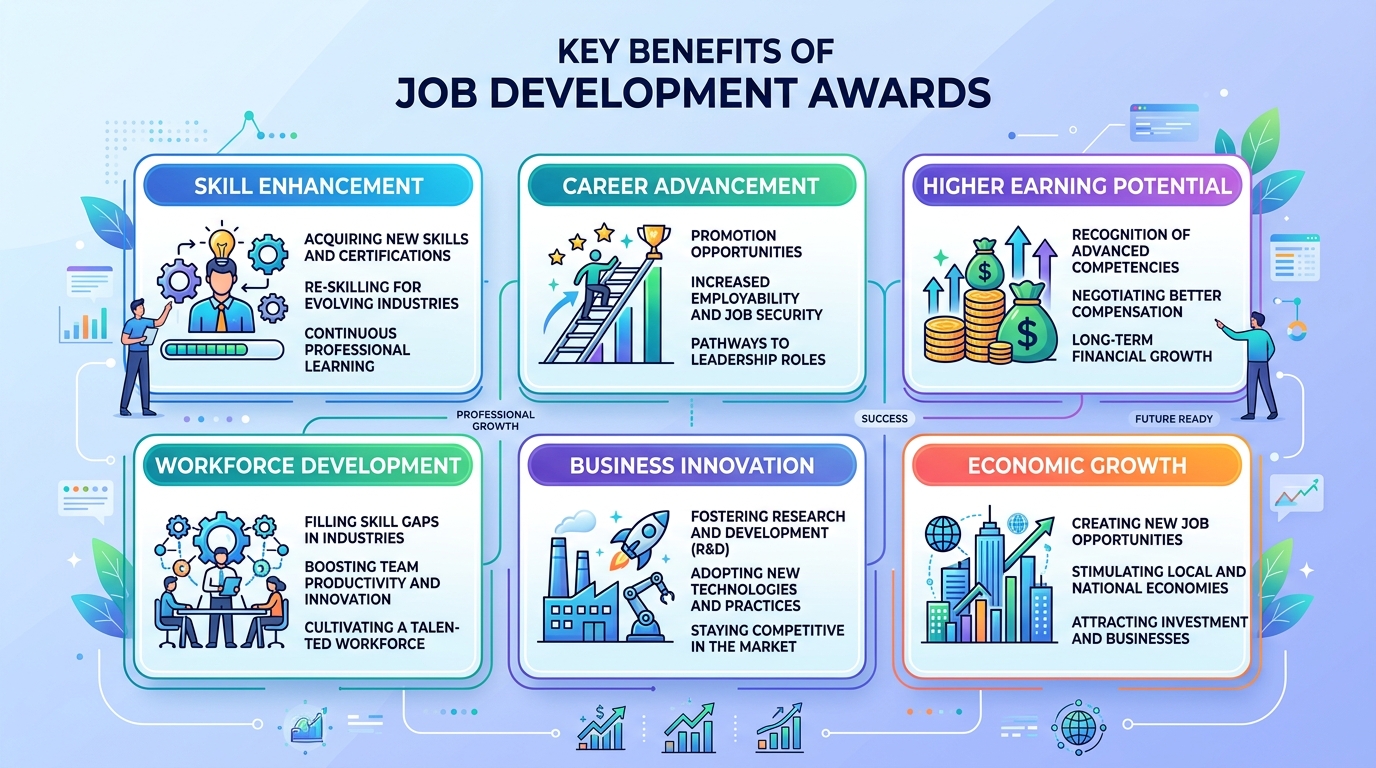
Securing funding through a Job Development Award offers substantial advantages that extend beyond simply covering tuition costs.
Financial Support for Upskilling
The most immediate benefit is the alleviation of financial burden. Professional courses, coding bootcamps, and specialized industry certifications often carry heavy price tags. These awards cover tuition, training materials, and sometimes even travel expenses, allowing you to focus entirely on learning rather than stressing about debt.
Enhanced Career Progression
Adding new credentials to your resume naturally increases your marketability. Professionals who continuously update their skill sets are more likely to secure promotions, negotiate higher salaries, and transition into leadership roles. The award catalyzes upward mobility.
Employer Advantages
Organizations that encourage their staff to apply for these awards reap massive benefits. Employers gain a more competent, efficient, and innovative workforce. Furthermore, companies that actively support professional development experience higher employee retention rates, as workers feel valued and see a clear path for internal growth.
Eligibility Criteria
While requirements vary depending on the specific program, most Job Development Awards share common eligibility benchmarks. Applicants typically need to be currently employed or transitioning into a high-demand sector. Many programs require a co-contribution, meaning the employer must cover a percentage of the training costs while the award covers the rest.
Additionally, the proposed training must directly relate to the applicant’s current role or an intended promotion. Grant committees look for clear evidence that the funded training will yield a tangible economic or professional benefit.
Step-by-Step Application Process
Securing a Job Development Award requires careful planning and a compelling narrative. Follow these steps to maximize your chances of approval.
1. Identify Your Goals
Before searching for an award, define exactly what you want to achieve. Pinpoint the specific skills you lack and identify the exact certification or course that will fill that gap. Clarity of purpose is essential for a strong application.
2. Gather Necessary Documentation
Most applications require a detailed training plan, cost estimates from recognized training providers, and a letter of support from your current employer. Ensure all quotes are accurate and that the training provider is accredited or widely recognized in your industry.
3. Submit a Strong Proposal
Your application must tell a cohesive story. Clearly articulate how the training will impact your daily work, benefit your employer, and contribute to your long-term career trajectory. Review the submission guidelines meticulously to ensure you meet every administrative requirement before hitting submit.
Industry Sectors Covered by Job Development Awards
Job Development Awards are not limited to one field; they span across multiple industries that require skilled professionals. Common sectors include healthcare, information technology, engineering, manufacturing, education, and hospitality. These programs are often designed to address labour shortages and future workforce demands. For example, IT professionals may receive funding for cybersecurity or cloud computing certifications, while healthcare workers may pursue advanced clinical training. Governments and organizations prioritize industries that show strong economic growth or skill gaps. Understanding your sector’s eligibility is crucial before applying. This ensures your chosen training aligns with funded priorities. By targeting high-demand industries, Job Development Awards help individuals remain competitive while also supporting national or regional workforce development strategies.
Common Mistakes in Applications
Many applicants fail to secure Job Development Awards due to avoidable mistakes. One of the most common errors is submitting incomplete documentation, such as missing training quotes or employer approval letters. Another issue is selecting training programs that are not aligned with career goals or industry demand. Weak proposals that lack clear outcomes or measurable benefits are often rejected. Some applicants also ignore eligibility criteria, wasting time on unsuitable programs. Poorly written applications without structured explanations reduce approval chances significantly. To improve success rates, applicants should carefully follow guidelines, double-check all documents, and clearly explain how the training will benefit both themselves and their employer. Attention to detail plays a critical role in approval.
Role of Employers in Funding Approval
Employers play a crucial role in the approval of Job Development Awards. In many cases, applications require employer endorsement or co-funding, which strengthens the proposal. Employers benefit directly from employee training, as it increases productivity and reduces skill gaps within the organization. They often help identify suitable training programs that align with business needs. A strong employer support letter can significantly increase approval chances by demonstrating real workplace impact. Additionally, some companies actively manage bulk applications for multiple employees to streamline workforce development. This partnership between employee and employer ensures that training investments deliver measurable organizational growth while also supporting individual career advancement.
Post-Training Career Opportunities
Completing training funded by Job Development Awards opens a wide range of career opportunities. Employees often qualify for promotions, leadership roles, or specialized positions after gaining new certifications. In competitive industries, additional qualifications significantly increase employability and salary potential. Some professionals even transition into entirely new career paths after completing funded programs. Employers also benefit by assigning more advanced responsibilities to trained staff, improving overall efficiency. Networking opportunities during training further expand career prospects, connecting individuals with industry experts and potential recruiters. Overall, the impact of these awards extends far beyond financial support, creating long-term professional growth and stability.
Long-Term Impact on Workforce Development

Job Development Awards contribute significantly to long-term workforce development. By funding skill enhancement programs, they help bridge the gap between education and industry requirements. This ensures that workers remain relevant in rapidly changing job markets. Over time, these programs improve national productivity and reduce unemployment rates in high-demand sectors. Businesses also benefit from a more skilled and adaptable workforce, leading to increased innovation and competitiveness. On a broader scale, these awards support economic growth by aligning training with market needs. The continuous cycle of learning and development strengthens both individual careers and the overall labor market, making it more resilient and future-ready.
Frequently Asked Questions (FAQ)
1. What specific expenses do these awards cover?
Job Development Awards typically cover direct training costs, such as tuition fees, examination costs, and necessary textbooks. Some comprehensive programs may also subsidize travel expenses or a portion of the employee’s wages during the training period, though this varies by grant.
2. Who is eligible to apply for these grants?
Eligibility usually includes current employees looking to upskill, unemployed individuals seeking entry into high-demand fields, and employers wanting to train their staff. Specific criteria depend heavily on the funding organization’s local economic goals.
3. Can employers apply on behalf of their employees?
Yes. In many cases, employers are actually the primary applicants. They apply for the award to offset the costs of bringing external trainers into the company or sending a cohort of employees to a specialized educational program.
4. How long does the approval process take?
The timeline ranges from a few weeks to several months. Government-funded awards often have specific intake periods and longer review cycles, while private industry grants might process applications on a rolling, expedited basis.
5. Are part-time employees eligible for funding?
Part-time employees are frequently eligible, provided the training aligns with their career development and benefits their employer. However, the funding amount might be prorated based on the hours worked compared to a full-time employee.
6. What makes a strong, winning application?
A winning application clearly connects the proposed training to measurable outcomes. It provides solid proof of cost, includes strong employer endorsement, and demonstrates exactly how the new skills will be applied in the workplace immediately after completion.
7. Do I need to repay the award if I leave my job?
Job Development Awards are generally structured as grants, not loans, meaning they do not require repayment. However, some employers may draft internal agreements requiring employees to stay with the company for a set period after the subsidized training.
8. Can I apply for multiple awards simultaneously?
You can usually apply for different awards, but you cannot receive double funding for the exact same expense. If multiple awards are granted, you must clearly allocate the funds to different aspects of your professional development to avoid violating grant terms.
9. What reporting is required after receiving the award?
Recipients are almost always required to submit proof of completion, such as a certificate or transcript. Employers might also need to provide brief reports detailing how the employee’s new skills have positively impacted business operations.
10. How do these awards impact taxation?
The tax implications depend on your local jurisdiction. In many regions, funds paid directly to a training institution are not considered taxable income for the employee. Always consult a tax professional or review the grant’s specific financial documentation.
Take the Next Step Toward Career Growth
Securing a Job Development Award represents a major milestone in your professional journey. By carefully understanding eligibility requirements and meticulously preparing your application, you position yourself for invaluable growth opportunities. These funds do more than just cover basic training costs; they unlock new career pathways, foster essential industry connections, and build lasting expertise. Take the time to review your career goals, consult with your employer, and begin gathering your documentation right now. Your future success depends on the strategic investments you make today. Start researching available awards and take that critical first step toward advancing your career.


Leave a Reply